
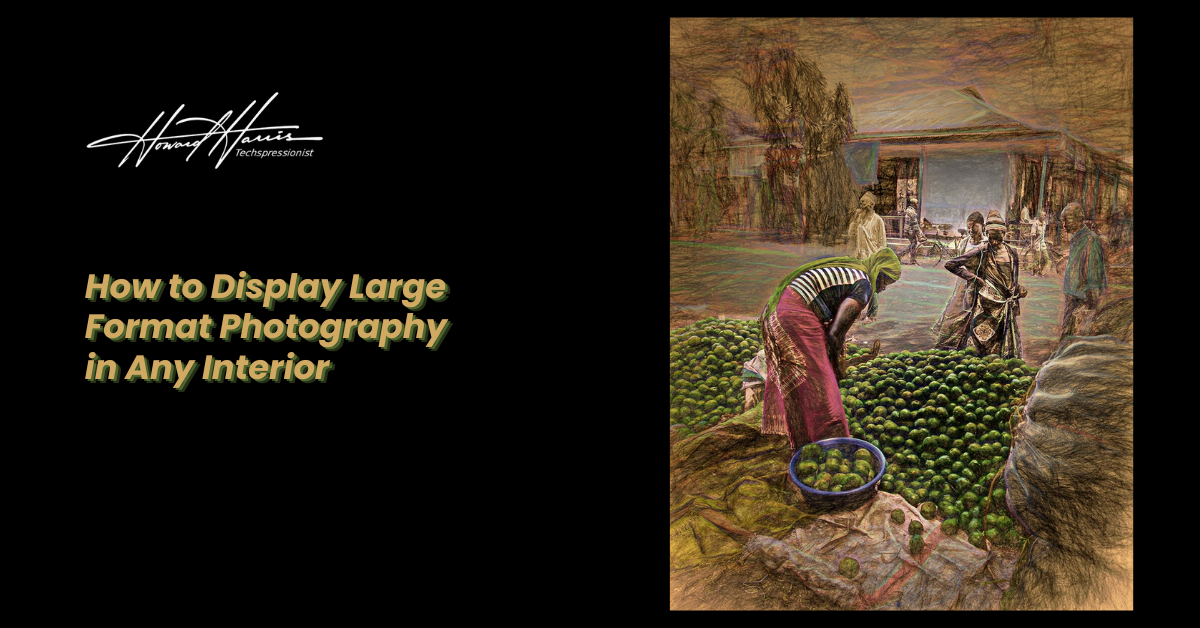
Large format photography can do more than fill an empty wall. Its size, depth, light, and position can change how a room feels. When the artwork uses layered photographic construction, display becomes part of the viewing experience. For anyone learning how to display fine art photography, the focus should be on giving the artwork enough space, light, and room for its visual depth to be experienced.
Start With the Artwork’s Visual Character
Begin with the artwork itself. Look at its colors, shapes, layers, and sense of movement. Dimensional photographic art can use clear acrylic surfaces and layered photographic imagery. A subtle grid can also form part of the construction.
These details give the piece a different presence from a standard flat print. Instead of treating the artwork as a background decoration, let its own design guide the space around it.
Consider Scale and Surrounding Space
Large artwork needs enough open space to remain clear and strong. A busy wall can take attention away from the image. A more open setting gives the artwork room to stand out. It also lets viewers move closer, step back, and see the piece from different positions.
There is no fixed wall size or spacing rule given for this artwork. The better approach is to consider the size of the piece and how it relates to the room.
Quick FAQ
How much space should surround large photography?
No fixed measurement is given. Leave enough open space for the artwork to remain clear and for viewers to move around and experience its dimensional qualities.
Let Light Shape the Viewing Experience
Light is not only there to make the artwork visible. In Harris’s dimensional photographic work, changes in light can influence the visual effect. Light interacts with the layered surfaces and can change how the artwork is perceived.
Because of this, think about the light already present in the room. Notice how it falls across the artwork during different parts of the day. There is no stated requirement for a certain bulb, light temperature, brightness, or lighting distance. Those choices should not be treated as fixed rules.
Use Viewing Angle to Reveal Dimension
A traditional photograph often gives you the same image from different positions. Layered photographic art can create a different experience. As you move, the relationship between the image layers can appear to change. Light can also interact with the surfaces in new ways.
That is worth considering when learning how to display fine art photography. Place the artwork where people can naturally move around it and view it from more than one angle. The viewer’s position then becomes part of the experience.
Quick FAQ
Why does viewing angle matter with dimensional photography?
Changing your position can change how the layered image is perceived. Light also interacts with the surfaces differently, creating a changing visual experience.
Make the Artwork Part of the Room
Large photographic art should connect with its surroundings without getting lost in them. Look at the wall, nearby objects, open areas, and available light. The room should give the artwork a clear place to exist.
This does not mean matching every color or decorating around the photograph. Instead, allow the artwork to keep its own visual identity. Space matters because the work explores the relationship between the image, viewer, light, and surrounding environment.
Display Layered Photographic Construction
The physical construction deserves attention. Harris’s patented process uses photographic constructions. A single image, which can be abstracted, is layered over itself on clear acrylic surfaces and placed over a subtle grid.
The acrylic is not simply a cover. It forms part of the construction.
The process can be understood as:
- Photographic image
- Layered construction
- Clear acrylic surfaces
- Subtle grid
- Dimensional visual effect
This construction is a major reason the work should be experienced as dimensional photographic art rather than an ordinary framed photograph.
Quick FAQ
Is the acrylic simply a protective cover?
No. Clear acrylic surfaces form part of the layered photographic construction and contribute to the physical depth and visual effect of the finished artwork.
Balance Technology With Interior Design
Technology is an important part of Harris’s artistic method, but it works alongside design. Harris has spent more than 35 years combining design and technology. His education includes a BFA from Kansas City Art Institute and a Master of Industrial Design from Pratt Institute.
His approach brings photography, design, technology, materials, and visual perception together. For an interior, this means the artwork does not need a complicated setting. Give the piece enough room to remain the main visual focus.
Choose a Location That Supports Perception
Think about how people will see the artwork when choosing its location. A wall that allows clear viewing from several positions can suit dimensional work well. Avoid placing it where furniture or other objects block the visual relationship with the piece.
Light also deserves attention. Since changing light can affect perception, the surrounding environment becomes part of the display. Understanding how to display fine art photography means looking beyond the wall itself and considering how people will experience the artwork within the space.
Quick FAQ
What should you consider before choosing a location?
Consider the artwork’s size, surrounding space, available light, and viewer movement. Choose a position where its layered construction can remain visible and visually clear.
Create a Strong Relationship Between Art and Space
Large format photography can become part of the room’s visual structure. The artwork can interact with open space, light, movement, and the viewer. Instead of seeing the piece as something separate from the interior, consider how the room frames the viewing experience.
This is especially important when the artwork has dimensional construction. Its physical layers and changing appearance give the viewer more to notice than a standard flat photograph.
Experience Large Format Photography as Dimensional Art
The strongest display approach is not about following a long list of decorating rules. Give the artwork space. Watch how light reaches it. Allow people to move around it. Let the layered construction remain visible.
When choosing display fine art photography, think about the complete experience rather than only the wall. Photography provides the image. Layering creates depth. Acrylic forms part of the construction. Light and viewing angle influence perception. Space brings all these elements together.
Give Dimensional Photography Room to Be Experienced
Discover how to display fine art photography in a way that respects light, space, movement, and dimensional detail. Explore the photographic work of Howard Harris and find artwork designed to create a changing visual experience within your interior.
