
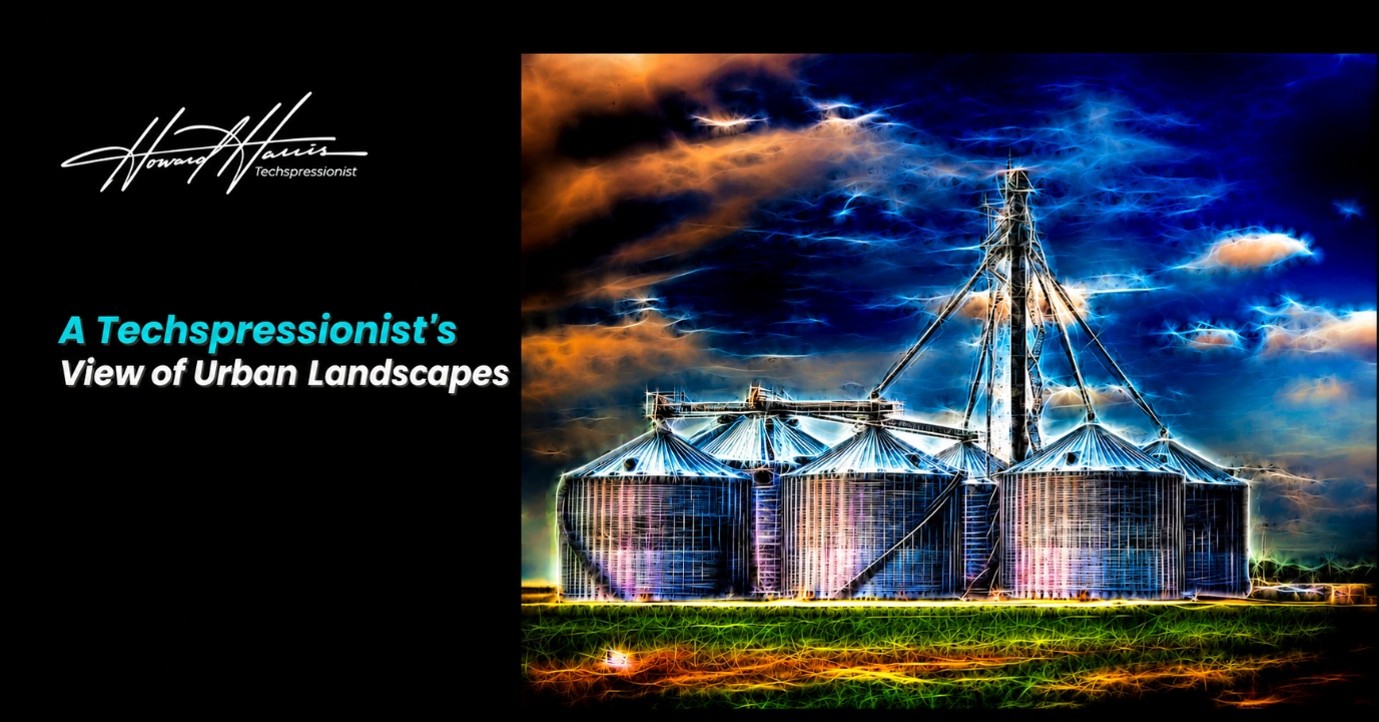
A city can be more than buildings, roads, and famous landmarks. It can also become a study of light, color, shape, space, and visual perception. This idea is central to a Techspressionist approach, where technology and artistic expression come together to create a different way of seeing an urban scene.
Howard Harris takes this approach beyond a flat photographic image. His work can transform a photograph through abstraction, layering, dimensional construction, and changes in light. As a result, cityscape photography prints can become physical artworks that offer more than a record of a place.
Beyond the Traditional Cityscape
A traditional city photograph often focuses on showing a location as clearly as possible. Harris takes a different path. His Cityscape collection includes recognizable places, buildings, streets, and urban views, but the final artwork can move far from a straightforward representation.
Works such as 107 Paris Night, 298 Notre Dame Paris, 322 Washington Monument, and 184 Guggenheim NY show how an urban subject can become a starting point for artistic exploration.
The location still matters. However, the artwork also draws attention to:
- Color, shape, and visual movement
- The way the image changes through artistic construction
This approach gives cityscape photography prints a stronger connection to contemporary art and design.
Turning Photographs Into Dimensional Art
For Harris, photography can become the starting point for a finished work of art. A photographic image can be abstracted and layered over itself on clear acrylic surfaces. A subtle grid can also become part of the construction. These choices create physical depth. They also change the way the artwork is seen from different positions.
This layered approach is connected to Harris’s patented process, covered by U.S. Patent No. 9,753,295, Apparatus and Method of Manufacture for a Layered Artwork, granted in 2017. The result is not simply a photograph placed on a wall. It is a constructed artwork in which the image, materials, light, and viewing position all play a role.
Layering Images With Light and Space
Light is central to how Harris’s dimensional work is experienced. As the viewer moves, the relationship between the image and its physical construction can change. That makes space part of the viewing experience.
The work also reflects Harris’s interest in visual perception. His background combines industrial design, fine art, computer science, color research, and technology. This mix supports his Techspressionist approach to cityscape photography prints.
Instead of asking only, “What place is this?” the artwork can also invite questions such as:
- How does the image change when viewed from another angle?
- How do light and color affect what the viewer notices?
The Role of the Grid in Cityscape Artwork
The grid is another visual element found in several Cityscape works. It can add structure to an image while also becoming part of the layered construction. Examples include 107 Paris Night, 6 Room with a View, 212 Goudy Church, 173 Bird Cage Alley 2500, and 184 Guggenheim NY.
The grid does not simply sit on top as decoration. Within Harris’s dimensional approach, it can work with the image, acrylic, light, and surrounding space. This gives selected cityscape photography prints a visual quality that changes as the viewer’s position changes.
From Architecture to Abstract Expression
Urban subjects can become the starting point for more abstract compositions. A building, monument, street, or city view can be reshaped through color, form, light, and visual design.
For example, 32 Central Park retains a clear sense of its New York setting. Other works, such as 173 Bird Cage Alley 2500 and 184 Guggenheim NY, move toward stronger shapes, lines, color, and graphic forms.
This range is important to Harris’s Cityscape collection. It shows that urban art can move between recognition and abstraction without losing its connection to the original subject.
Cityscape Photography Prints for Contemporary Spaces
The size and presentation of an artwork can change how it relates to a room. Harris offers Cityscape works in several standard sizes, from 16 × 20 inches to 40 × 60 inches. Other sizes can also be requested.
When considering cityscape photography prints for a contemporary space, think about:
- The amount of wall space available
- The distance from which the artwork will usually be viewed
These points matter because dimensional artwork can be experienced from different positions. A larger piece can also give the construction more room to become part of the visual character of a space.
Choosing a Presentation for Cityscape Artwork
Harris offers two main print types for Cityscape artwork: Fine Art Sublimation Print and Giclée Archival Print. The construction and role of the materials differ between these choices.
| Presentation | Main Features |
| Fine Art Sublimation Print | The image is infused into the coating of Dye Sublimation Aluminum and finished with a protective polymer coating. |
| Aluminum with acrylic overlay | A Dye Sublimation Aluminum base is combined with a suspended acrylic top image as part of the artwork’s construction. |
| Giclée Archival Print | Archival-grade acid-free paper, a solid wood frame, mounted board, and optical-grade clear acrylic are used for the presentation. |
For aluminum artwork without an acrylic overlay, the image is printed directly onto Dye Sublimation Aluminum. A 3/4-inch black aluminum frame is mounted on the back.
Mounting options also matter. A French cleat is supplied and recommended for these heavier artworks, while the wire-and-ring system is provided as a short-term option.
A Different Way to Experience Urban Landscapes
Harris’s Cityscape work brings several areas together: photography, design, technology, materials, and visual perception.
That combination gives urban subjects a new role. A building can become a study of shape. A street can become a study of movement. A familiar landmark can become an exploration of color, space, and layered imagery.
This is what makes the Techspressionist approach different from simply documenting a city. The photograph becomes part of a larger physical artwork.
For collectors considering cityscape photography prints, this distinction can be useful. The focus is not only on the scene captured in the image. It is also on how that image is constructed and experienced.
Explore Cityscape Photography Prints
Explore cityscape photography prints from Howard Harris Photo to see how urban subjects can move from photographic imagery into dimensional contemporary artwork.
The Cityscape collection includes works ranging from recognizable architectural views to highly transformed compositions. Each piece offers a different combination of subject, color, construction, and visual expression.
Frequently Asked Questions
What is Techspressionist cityscape art?
Techspressionist cityscape art combines photographic imagery with technology, artistic construction, light, color, space, and visual perception to create a dimensional view of urban subjects.
What materials are used for Cityscape artwork?
Depending on the presentation, materials include dye-sublimation aluminum, clear acrylic, archival paper, solid wood framing, mounted board, and protective finishes.
What sizes are available for Cityscape artwork?
Standard sizes range from 16 × 20 inches to 40 × 60 inches. Other sizes can be requested when a different scale is needed for a particular space.
What is the difference between aluminum and Giclée presentation?
Aluminum uses a dye-sublimation print onto aluminum, while Giclée uses archival paper with wood framing, mounted board, and clear acrylic for presentation and protection.
