
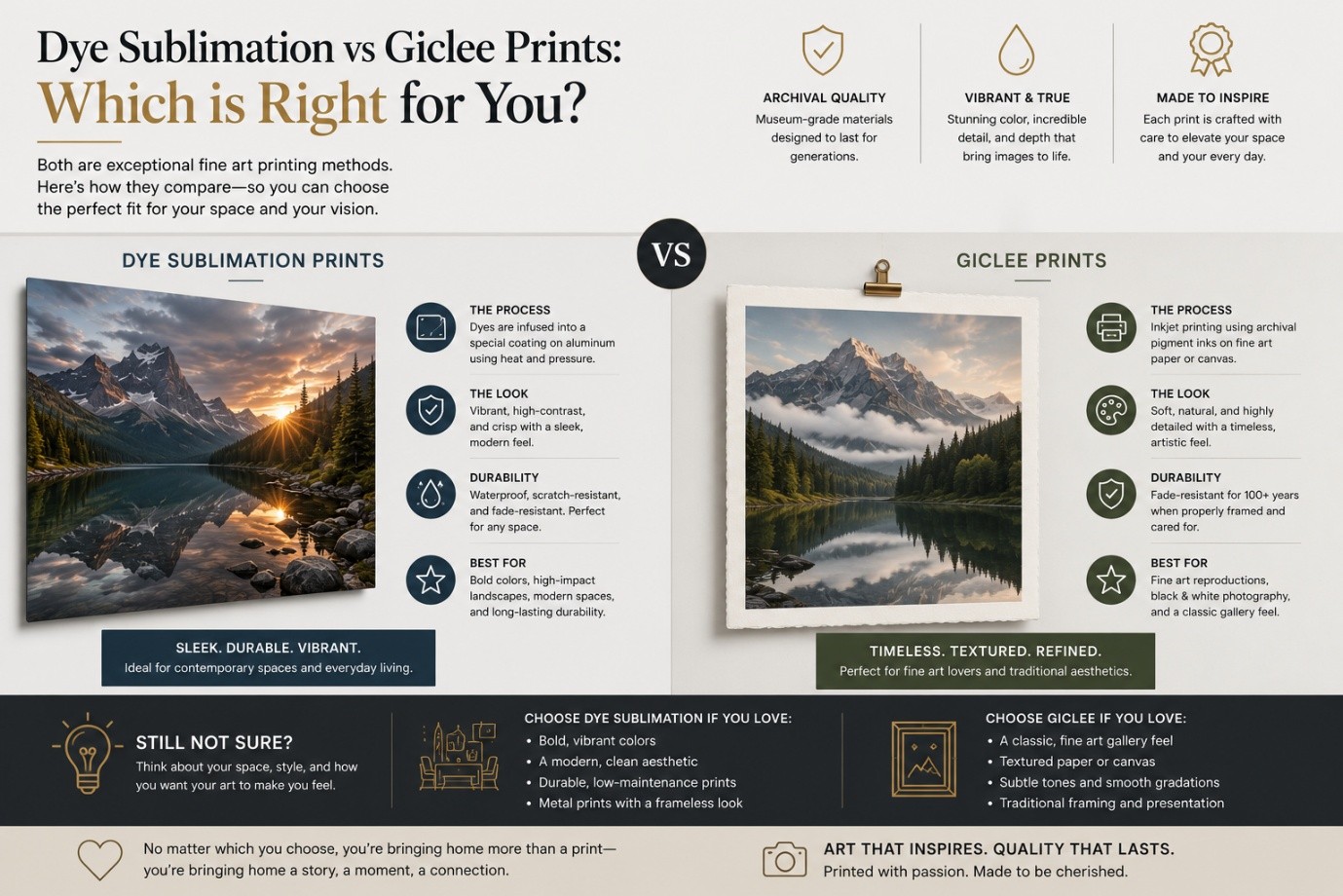
Choosing the right art print is not only about looks. It is also about how the artwork behaves in a space over time. This becomes even more important with dye sublimation aluminum art prints, where the image is not just printed, but built into a reflective metal surface that reacts with light and environment.
Howard Harris’s photography adds another layer to this idea. His work is not flat. It is created as techspressionistic dimensional photographic images, where light, angle, and position all change how the artwork appears. So the print method directly affects how the art is experienced in a home or gallery.
Understanding Dye Sublimation vs Giclee in Fine Art Printing
There are two main directions in fine art printing today. One is traditional and stable. The other is modern and interactive. Giclee prints focus on paper-based reproduction. Dye sublimation focuses on metal-based visual depth.
In dye sublimation aluminum art prints, the image becomes part of the surface, not something placed on top of it. This difference changes everything about how the artwork feels in real life.
Understanding Fine Art Print Methods: A Modern Overview
Fine art printing has moved beyond simple reproduction. Today, it also includes experience-based presentation.
Quick FAQ
What is the biggest shift in modern print methods?
The biggest shift is from flat viewing to environmental interaction. Art now responds to light, space, and angle, creating a changing visual experience instead of a fixed image.
What Are Giclee Prints and How They Work in Fine Art Reproduction
Giclee prints are created using archival ink on textured paper. They are known for accuracy, detail, and consistency. They usually stay visually stable. This means the image looks the same from every angle and under most lighting conditions.
Many collectors prefer this for traditional framing and archival display. However, they do not change with space or movement. The experience remains fixed and predictable.
What Are Dye Sublimation Aluminum Art Prints and Why They Stand Out
Dye sublimation works in a very different way. The image is transferred into a coated aluminum surface using heat. The color becomes part of the metal itself.
This creates:
- Strong color brightness
- Reflective depth
- Smooth modern finish
Quick FAQ
Why does aluminum change the viewing experience?
Because aluminum reflects light differently than paper. It allows the image to respond to lighting and viewing angle, creating a shifting visual effect instead of a static surface.
Key Differences Between Giclee Prints and Dye Sublimation Techniques
The difference is not only technical. It is also experiential.
| Feature | Giclee Prints | Dye Sublimation Aluminum Art Prints |
|---|---|---|
| Surface | Paper | Aluminum |
| Visual behavior | Static | Light-reactive |
| Texture | Soft | Smooth metallic |
| Experience | Fixed | Changing with environment |
In simple terms, one stays the same. The other changes with the room.
Material Quality, Surface Finish, and Texture Comparison
Giclee prints feel soft and traditional because they sit on paper. The texture is subtle and familiar. On the other hand, dye sublimation aluminum art prints feel solid and modern. The surface reflects light and creates depth that feels physical, not just visual.
Quick FAQ
Do dye sublimation prints look different in different lighting?
Yes. Lighting plays a major role. Bright light increases reflection and depth, while softer light creates a calmer and more subtle visual effect.
Color Accuracy, Detail Rendering, and Archival Longevity
Both methods preserve detail well, but in different ways. Giclee printing focuses on ink precision and long-term stability. Dye sublimation focuses on vibrancy and how light interacts with color. In Howard Harris’s work, dye sublimation aluminum art prints are often preferred because the goal is not only accuracy, but also visual depth and movement across layers.
Best Use Cases for Giclee Prints in Home and Gallery Spaces
Giclee prints work best in spaces that need consistency. They are often used for:
- Traditional framed photography
- Controlled lighting environments
- Classic art collections
They do not change visually, which makes them predictable in every setting.
Why Dye Sublimation Aluminum Art Prints Are Preferred for Contemporary Displays
Modern interiors often rely on light, reflection, and open space. This is where aluminum-based prints stand out. In Howard Harris’s system, images are described as techspressionistic dimensional photographic images. These works often combine aluminum bases with acrylic layers to build depth.
Quick FAQ
What makes these prints feel dimensional?
The combination of aluminum and layered structure creates depth. Light passes through and reflects between surfaces, making the image feel like it has multiple visual levels.
How to Choose Between Dye Sublimation vs Giclee Based on Your Space and Style
The right choice depends on how you want the artwork to behave.
- Choose giclee if you want a stable, classic display
- Choose aluminum sublimation if you want movement and reflection
- Choose layered systems if your space has changing light
The experience is the key difference, not just the material.
Investing in Fine Art Printing Solutions for Long-Term Value
Fine art is not only about decoration. It is also about long-term visual value. In reflective systems like dye sublimation aluminum art prints, the artwork continues to feel fresh because it responds to environmental changes.
At Harris Photography, this method is used to create dimensional photographic works that move beyond flat presentation and into spatial experience.
Quick FAQ
Which print type is better for modern interiors?
Dye sublimation aluminum prints are often preferred for modern interiors because they interact with light and space, making them feel more dynamic and visually engaging over time.
